
ПРИНЦИПЫ И ПЕРСПЕКТИВЫ МЕЖДУНАРОДНОГО ЭКСПЕРИМЕНТАЛЬНОГО ТЕРМОЯДЕРНОГО РЕАКТОРА (ИТЭР)
Introduction
The world has an energy issue: the demand for electricity increases every year, the race is on for a sustainable and abundant energy supply.
Energy generated from nuclear fusion could be one answer and ITER - one of the most ambitious energy research projects ever seen – is at the forefront of fusion research [1].
ITER is anexperimentalfusionreactorbased on the "tokamak" concept - a toroidal (donut-shaped) magnetic machine designed to create and maintain the conditions for controlled fusion reactions. The term "tokamak" stands for "toroidal chamber with magnetic coils.
Theaimof this work is to analyze the International Thermonuclear Experimental Reactor (ITER) as a pivotal project in realizing the potential of fusion energy. The central focus is on its mission to demonstrate the scientific and technological feasibility of generating energy from fusion on a commercial scale.
The key objectives of this research are:
1. To explain the fundamental principles of thermonuclear fusion and the tokamak concept that forms the basis of the ITER design.
2. To describe the key components of a tokamak reactor and their respective functions in creating and sustaining fusion reactions.
3. To conduct a comparative analysis of fusion energy's prospects, highlighting its potential advantages and current limitations in comparison to existing nuclear fission technologies.
Fusion reaction
What physical phenomenon underlies this project? The possibility of thermonuclear fusion as a large-scale and carbon-free source of energy based on the same principle that powers our Sun and stars [2]: in conditions of high temperatures and gravity, hydrogen nuclei collide, turn into heavier helium atoms and release a huge amount of energy.
Twentieth-century fusion science identified the most efficient fusion reaction in the laboratory setting to be the reaction between two hydrogen isotopes, deuterium (D) and tritium (T), as the DT fusion reaction produces the highest energy gain at the "lowest" temperatures.
Three conditions must be fulfilled to achieve fusion in a laboratory: very high temperature (on the order of 150,000,000 °C); sufficient plasma particle density (to increase the likelihood that collisions do occur); and sufficient confinement time (to hold the plasma, which has a propensity to expand, within a defined volume) [3].
Operation principle of Tokamak
The key aspects of tokamak operation:
1. The heart of a tokamak is its donut-shaped vacuum vessel.Inside, under the influence of extreme heat and pressure, gaseous hydrogen fuel becomes a plasma—a hot, electrically charged gas.
2. The charged particles of the plasma can be shaped and controlled by the massive magnetic coils placed around the vessel. Powerful magnets create two main magnetic fields: atoroidal fieldgoing around the torus anda poloidal fieldcrossing it (Fig.1).
3. The charged particles spiral along the magnetic field lines without hitting the walls.
4. Various heating systems heat the plasma to over100 million °Cfor fusion reactions.
5. Particles undergo fusion at such extreme temperatures can overcome their electromagnetic repulsion on collision and fuse, releasing huge amounts of energy.
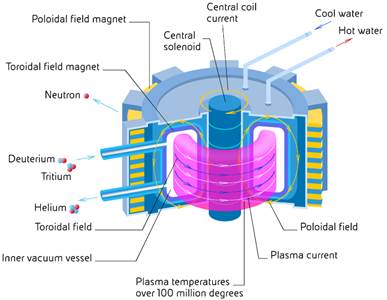
Figure 1 - Simplified Tokamak scheme [4]
The main components of a Thermonuclear Reactor
Magnets produce the magnetic fields that confine, shape and control the ITER plasma. The magnet system comprises toroidal field (TF) coils, a central solenoid (CS), external poloidal field (PF) coils, and correction coils (CC) [3].
Vacuum vessel provides a high-vacuum environment for the plasma, improves radiation shielding and plasma stability, acts as the primary confinement barrier for radioactivity, and provides support for in-vessel components such as theblanketand thedivertor. In its doughnut-shaped chamber, or torus, the plasma particles spiral around continuously without touching the walls. Cooling water circulating through the vessel's double steel walls remove the heat generated during operation.
Blanket modules completely cover the inner walls of thevacuum vessel protect the steel structurefrom the heat and high-energy neutrons produced by the fusion reactions.
Divertor extractsheat andashproduced by the fusion reaction, minimizes plasma contamination, and protects the surrounding walls from thermal and neutronic loads.
Cryostat is the largest steel high-vacuum pressure chamber which provides the high vacuum, ultra-cool environment for the ITER vacuum vessel and the superconducting magnets [5].
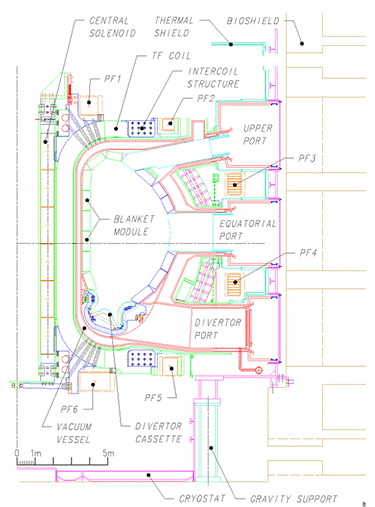
Figure 2 - ITER Tokamak Cross-section [3]
Comparison with modern reactors
Fusion power plants based on the tokamak concept hold great prospect as future energy sources due to benefits like:
1. Abundant energy: At the output, it should give ten times more energy than is spent on maintaining the burning of the plasma.
2. No long-lived radioactive waste: This radioactivity disappears within 50-100 years.
3. No greenhouse gases emissions.
4. Abundant fuel source: Deuteriumcan be obtained fromseawater,whiletritiumcan be produced fromlithium. The fuel supply is unlimited.
5. Nuclear fusion reactors are not subject to the risk of uncontrolled chain reactions, which can cause extremely dangerous accidents and the eventual explosion of the reactor itself.
At the same time, ITER also has disadvantages:
1. The capacity of the ITER is 500 thermal megawatts. For comparison, the constant thermal capacity of a conventional BN-800 nuclear reactor is more than 2,000 megawatts.
2. Another disappointing factor in the operation of a thermonuclear reactor is its efficiency of 20% (low estimated efficiency: A huge amount of energy will be spent on the operation of powerful magnets, cooling and heating systems. The net energy output, even with success, may not be as impressive), while the efficiency of nuclear power plants is 33-34%.
3. Various elements of the ITER project are being developed and delivered to the construction site from all over the world. This is a complex and expensive design.
To sum up, thermonuclear fusion is most affordable and the cleanest source of energy with minimal environmental impact. Moreover, it provides inexhaustible, safe and cheap fuel.
Therefore, the main goal of ITER is to achievefusion power production at power plant scale, breaking new ground in fusion science and contributing to the construction of thermonuclear reactors.
Конфликт интересов
Библиографическая ссылка
URL: https://www.eduherald.ru/article/view?id=21916 (дата обращения: 10.10.2026).